The Evolution of Internet Music Nerds
From /mu/ to Anthony Fantano, TikTok, and beyond.
April 15, 2026
BY Eden DaSilva

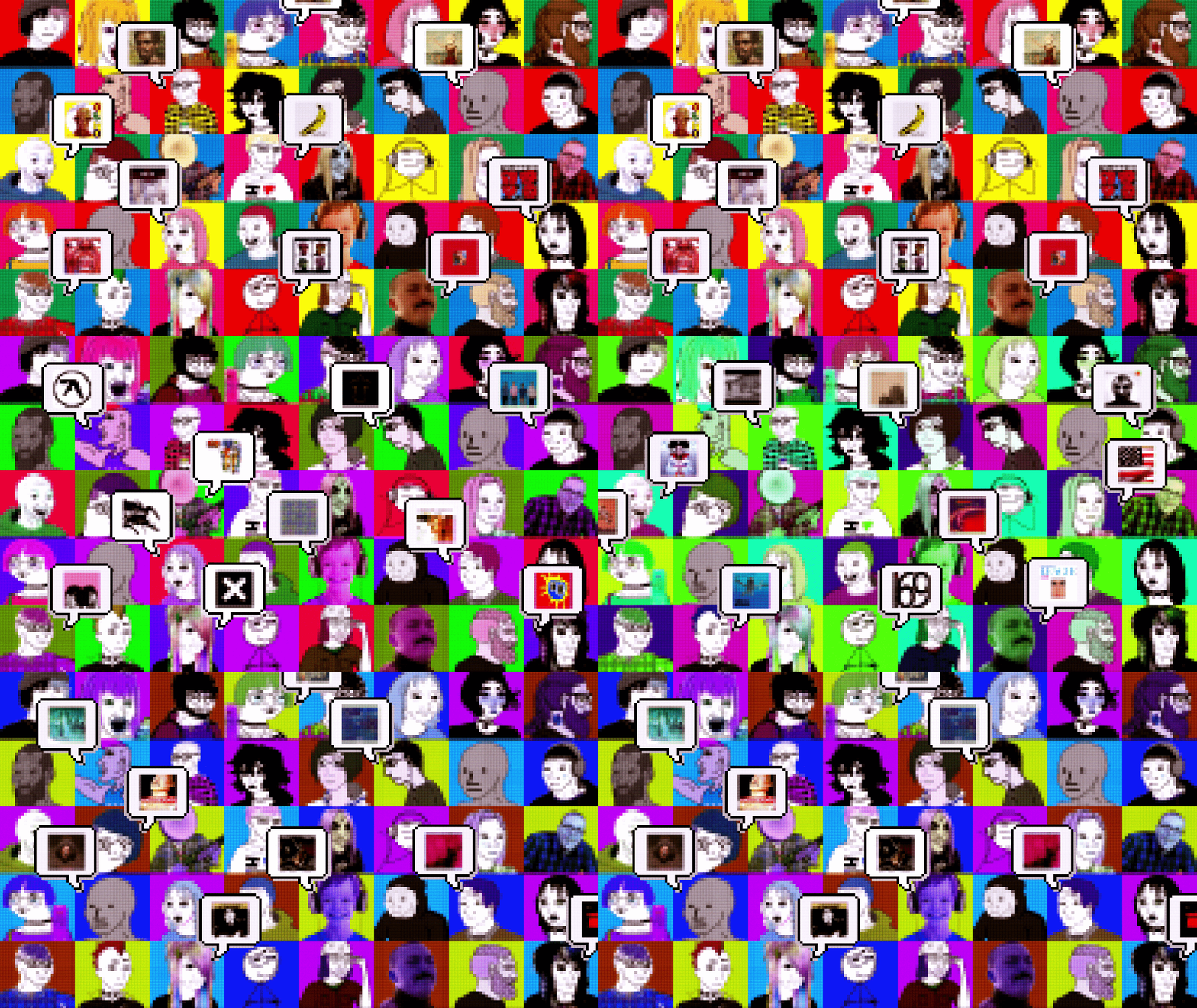
Design by Jp Consuegra
From /mu/ to Anthony Fantano, TikTok, and beyond.
April 15, 2026
BY Eden DaSilva
Before social media algorithms dictated the content we consume, and platforms like Spotify allowed for virtually every song in existence to be streamed at a moment’s notice, the world of niche internet music discovery took place within a web of interconnected online communities.
Music nerds congregated on independent blogs, forums, and file sharing platforms to discover and discuss artists that fell outside the scope of established publications and mainstream radio play. Fans and creators of intentionally weird and left-field music became communitized through online scenes, categorized into microgenres like chillwave, vaporwave, seapunk, and witch house. During this transitional period between hoping a talent scout catches your band at a local bar, to artists casting snippets into the digital ether in search of a viral hit, the online music landscape was—for a brief moment—democratized in a way that encouraged truly organic peer-led discovery.
For UMass Amherst students Dan Barrett and Tim Macuga, the internet offered new opportunities for their band called Have a Nice Life, whose initial melancholic performances Macuga describes as “trolling.”
“The nominal premise was, ‘What if Dashboard Confessional was Taxi Driver’ and we showed up at college coffee houses?” he tells me over a video call. “We were writing songs, but not taking it too seriously. The ambition was that we could do whatever we want, so we should do whatever we want. And where is it really gonna go? Who cares.”
As far as their aspirations for recognition and success, Macuga says his main goal was for their CDs to be carried by Aquarius Records in San Francisco, an independent shop he had long admired. Throughout the mid 2000s, the duo began writing songs and recording on GarageBand with minimal budget. The final result became their debut album Deathconscioussness, an 85-minute double LP mixing their influences of post-rock, shoegaze, and black metal. Upon release in 2008, the project failed to receive attention from any established music critics or publications. “The only promotion we did was sending stuff to the Aquarius mail order catalogue store, and sending some copies of the CDs to a few bloggers that Dan happened to follow or know,” Macuga says. “Everything just sort of took off from there.”
Over the next few years, Have A Nice Life developed a cult following on /mu/, a subsection of 4chan dedicated to music discussion. “I posted the album there pretty early. I was on /mu/ a bit,” Barrett admits. “It’s not like people said, ‘Wow, we love this album’, it was more like, ‘Hey, fuck you, you’re gay,’ kind of stuff, because that’s what 4chan was…I remember coming back a few years later and there’d been kind of a change in the sense of people actually liking the record, but I didn't really see it become an accepted favorite album. I think that happened even later.”
By the time I first discovered /mu/ in 2012 as a fledgling teenage music nerd, Deathconsciousness was regularly placed alongside records from My Bloody Valentine, Neutral Milk Hotel, Animal Collective, and Swans on charts made to introduce newcomers to ‘/mu/core,’ a catchall term for the frequently-discussed albums seen as consensus favorites on the board. New users were typically discouraged from posting altogether until working their way through these charts and taking in the dozens of albums considered to be “essential listening” within the community. The aristocratic terms “plebian” and “patrician” were thrown around constantly, either to denigrate someone’s uninitiated taste as basic and "entry-level,” or to pretentiously elevate their own preferences.
Compared to the dominant social media platforms of the time, /mu/’s grasp of the era’s emerging meme culture felt cutting edge. Even though the humor was exceedingly juvenile, typically communicated via ironic shitposts and comics crudely drawn in Microsoft Paint, an impressive depth of music literacy was required to understand their niche references and countless inside jokes.
Jeff Mangum, lead singer of the beloved indie band Neutral Milk Hotel, was canonically in love with Anne Frank. Loveless by My Bloody Valentine sounded like an orchestra of vacuums, while the drone metal band Sunn O))) was compared to a noisy fridge. Voices of North American Owls, a 200-track collection of wild owl field recordings, was hailed as the pinnacle of music. Users were seemingly obsessed with Piero Scaruffi, an obscure Italian-American academic who self-published music criticism on his archaic ‘90s-style website, and Pitchfork writers like Ian Cohen and Ryan Schreiber were household names, if only for the purpose of more articulately disparaging their opinions.

With music consumption still heavily centered around CD sales and iTunes downloads, /mu/ was home to a thriving culture of “sharethreads,” where anyone could request and post links to albums on filesharing platforms like Mediafire. Users obsessively curated and archived obscure releases, shared along with various “essentials charts” created for every genre imaginable. These threads were massively helpful, not only for me to explore new music on my iPod, but also playing a large hand in the rediscovery of music almost lost to time. Once nearly-forgotten bands like Duster and Panchiko gained cult followings due to these.
Contrary to the typical archetype of a 4chan poster—a basement-dwelling internet troll obsessed with video games and Japanese culture—the average user of /mu/ was more likely a millennial blog era hipster with browser tabs open to Pitchfork, Last.fm and Topsters, deliberating which albums to include in carefully curated charts to showcase their music taste. Barret’s earlier admission of sharing his own music on /mu/ is a move shamelessly embraced by JPEGMafia and famously denied by Lorde. Through the height of the board's cultural pull and influence in the early 2010’s, 4chan hosted scheduled Q&As with deadmau5, Anamanaguchi and Andrew WK, received a shoutout from Lil B in his Nardwuar interview, and played an instrumental role in the early careers of Car Seat Headrest, Kitty (fka Kitty Pryde), Death Grips, and Anthony Fantano.

Photo from @theneedledrop on X.
Now regarded as the most influential music critic of the internet era, Anthony Fantano launched his YouTube channel The Needle Drop in 2009, proclaiming himself the “internet’s busiest music nerd” and reviewing everything from Slipknot tracks, Lil B mixtapes, and popular indie releases. Hopping on a phone call with Fantano feels like a full circle moment for my teenage self. Like many others in the YouTuber’s early fanbase, I first subscribed to The Needle Drop after seeing the critic’s face posted on 4chan on a near-daily basis more than a decade ago. Before starting his YouTube channel, Fantano mentions platforms like Soulseek, LiveJournal, Newgrounds, 4chan, and various local forums as some of the places he visited for music discovery online. Though he kept up with a number of YouTube channels, Fantano tells me over the phone that a lack of content focused on music discussion around this time.
“I watched quite a bit of YouTube—what I was watching around that time period was pretty much anybody who made a platform out of diving deep into whatever it was they were obsessed with. After doing what I was doing in the music blog sphere and writing for NPR Music on occasion, I was like, Why couldn't I do that just talking about music?” he says.
Writing, shooting, and editing all of his videos himself in his spare time while working at a pizza restaurant, Fantano found himself too busy to focus on self-promotion. “I didn't have time to do anything else but make content and go to work. I was very tunnel visioned into just doing what I was doing consistently and slowly improving, to the point that I had completely given up pretty much any and all internet socializing,” he says. Once his channel started to make some money, he quit his job in 2012 and went all in on The Needle Drop. “That was around the time you probably ran across me on there. I didn't know this, but I was getting posted like crazy. I didn't realize it until around when Radiohead came out with The King of Limbs, somebody left a comment on my channel that was like, ‘You better give The King of Limbs a good score, /mu/ is gonna come after you’. I went on /mu/, and there were like 4 threads about me.”
An early champion of Death Grips, Fantano issued their debut album The Money Store his first-ever perfect score of 10 on a new release, unintentionally becoming the face of the group’s meme-driven online fandom. Alongside their rabid fanbase on /mu/, his enthusiastic endorsement helped to build their massive cult following. “I know that I definitely played a role—a pretty considerable role,” Fantano says when I credit him with this. “I do feel there is a lot of the music meta and music taste that has sort of become normalized, or more widely accepted because of me. I think there was just a novelty to what I was saying, and the way that I was doing what I was doing that kind of made it exciting or more subversive than what people were used to getting from other music publications at the time.”

Fantano and MC Ride.
While in many ways I look back on this time with a sense of teenage nostalgia, it’s impossible to ignore the fact that 4chan carries a bad reputation—and deservedly so. Although /mu/ was relatively tame in comparison to some of the more disturbing communities that existed on the platform, the culture of deeply-engrained misogyny and casual slur-hurling was present throughout the entire website. In December of 2014, the Tumblr page Sexism in Music published a post calling out the indie rock band DIIV’s bassist Devin Ruben Perez for publicly making numerous sexist, homophobic and racist comments on /mu/ under his tripcode-verified username. The band issued a statement denouncing his behaviour, and eventually parted ways with Perez.
During the American election cycle in 2016, the growing number of far-right trolls attracted to 4chan reached a tipping point, spilling over into the mostly apolitical or left-leaning hobbyist boards and polluting the communities with an influx of toxicity and vitriol. Much of the board’s aging user base moved on to more moderated places for discourse like Reddit, Twitter and Rate Your Music, or kept up with The Needle Drop for new releases and recommendations.
Coinciding with the noticeable drop in discussion quality, a mass adoption of streaming services had rendered /mu/’s culture of filesharing and user-led artist discovery obsolete. Rather than combing through sharethreads or downloading charts to find new bands to check out, streaming platforms were suddenly capable of creating playlists perfectly curated to an individual's listening habits. When my family signed up for a Spotify plan, my iPod found a new home in a desk drawer, and the hundreds of gigabytes of music diligently organized on my hard drive suddenly felt useless. Between my new responsibilities of university assignments and employment, and most discussion on /mu/ quickly deteriorating into reactionary takes regarding the American culture war, my once daily visits began to dwindle. Just a few years prior, visiting the board felt like being part of a secret (albeit edgelordian) club on the cutting edge of trendy internet music. All of a sudden, the community became a ghost town, occasionally populated by stubborn stragglers waxing poetic about old times.

“I think we have to look back at that time with sort of a side-eye. Why was this board on this website as popular as it was?” Fantano reflects. “Because they're looking at the state of it now—which is obviously horrific—but they're not really taking into account how underdeveloped other platforms were in terms of music discourse at the time. The sorts of Reddit communities that you have now didn't exist yet, the more specific discourse spaces that you have around certain genres with hundreds of thousands of followers weren't there. It's not like people were avoiding those spaces in favor of 4chan. As those spaces developed, people slowly realized, ‘Maybe I just want to be able to have music discourse around this one genre that I’m specifically interested in.’ Or, ‘Maybe I would rather be able to engage in music discourse that doesn't involve having to run across a racist thread every two or three pages.’”
In 2017, The Needle Drop hit 1 million subscribers on YouTube. His channel had grown more popular than the board itself, and regularly reached a wider audience with his album reviews than most mainstream publications. Music receiving his yellow-flanneled stamp of approval was now referred to as “Fantano-core,” a taste largely meshing the consensus classics of /mu/core with his own penchant for poptimism and alternative rap. He lists Danny Brown, JPEGMafia, clipping., and Brockhampton as examples of acts that his on-camera endorsements helped draw attention to.
“There's a photo on the internet of this guy standing for a VIP-style photo op with Carly Rae Jepsen, and he’s wearing a Swans t-shirt. I know that’s definitely my fault,” he laughs.

Carly Rae Jepsen and a Swans fan.
He acknowledges that the reach of his channel—which recently hit 3 million subscribers—has had a noticeable impact on the greater world of music fans online. “I do hold water when it comes to circles of people that are literally taking their free time to sit down and rate and analyze music. As a result of that, call it Fantano-core, when you go on Rate Your Music there's a lot of people that write their reviews out, and then they'll end it off with like, ‘I'm feeling a light three on this…’—using my terminology to rate the record and moving away from the decimal system.”
The Needle Drop’s signature rating system has become so widespread that in 2022, it was used by Drake when he personally reached out to Fantano over Instagram to rate the critic’s existence a “light to decent 1.” When I ask if there was any particular moment when he came to realize the level of influence he held as a tastemaker, he thinks for a moment before recounting their viral interaction. “It's hard not to feel like you're making some kind of impact when the biggest rapper on the planet is angry in your DMs on a Wednesday night at midnight.”

Today, the music proliferated through loosely-defined labels like /mu/core and Fantano-core is more popular than ever. Until a younger coworker informed me that bands like My Bloody Valentine and Swans were favorites amongst the community on RateYourMusic, I hadn’t had any clue that the albums considered classics on 4chan had been embraced by a new generation of music nerds. Scrolling through the website’s top 100 albums of all time list, I recognized dozens of Pitchfork Best New Music picks, Fantano 10s, and covers relentlessly spammed on /mu/ a decade prior—an amalgamation of records now adored in online circles, yet likely still unknown to the average person on the street.
“I feel like the early 2010s were very much defined by the way the internet changed how music consumption works,” Fantano says of this. “We're really sort of discussing niche styles of music that wouldn't have a platform anywhere else. That's why they're thriving in the spaces that they are, and getting name-checked by virtue of the spaces that they're being discovered in.”
Though Have A Nice Life’s early success can be traced back to blogs and forums, their continued popularity on platforms like Rate Your Music has introduced them to a much larger audience today. Deathconsciousness currently sits at #58 overall on the site’s all time charts, and the opening track “A Quick One Before The Eternal Worm Devours Connecticut” has gone viral on TikTok multiple times.
Fans on the band’s subreddit often credit various memes and shortform videos as their initial introduction to their work. In his day job as a high school English teacher, Macuga has witnessed a younger audience discovering his music firsthand.
“As far as kids knowing [I’m in this cult-famous band], that's been an interesting road,” he says. “In 2015, maybe 2013, there were a few kids where my reputation did precede me, and they’d poke their heads in after school like, ‘Are you the guy from Have A Nice Life?’ But I would say in the past five years, that’s when it has definitely hit. Our music will be in Reels, it will be on TikTok, it's become kind of a legacy, like kids discovering Duster and these bands that are well before their time, but are present in their social media lives in some sort of way.”

Have A Nice Life. Photo from band's Facebook.
Despite their enduring legacy, Macuga and Barrett both have their doubts that Deathconsciousness would be able to win the favor of the algorithm and reach the same audience if they debuted in today’s era of music streaming.
“I don’t know how to recreate it, and it drives me fucking crazy. If you put a gun to my head and said do it again, I have zero idea how I would do that,” Barrett says. “[Music] discovery is so different now. We happened to be in this unique spot in the early period of the internet where you could post things online and get them to people with very few obstacles in the way—before there were 50 billion bands doing the exact same thing.”
Growing uncool and falling out of touch through my old age (late 20s), my listening habits have changed drastically since the days of music forums. By time a new artist like Chappell Roan or EsDeeKid lands on my radar, it’s often due to their hype bubbling over from algorithms far outside my social media feeds, suddenly exposing me to new music and rabid fanbases thriving in corners of the internet I didn’t know existed. With today’s social media landscape being so splintered, it feels like a near impossibility for any sort of new-gen tastemaker to reach a level of universal influence once held by blogs and early YouTubers. Before getting off the phone with Fantano, I ask if he feels like there’s any successor primed to take his place, or if music discovery will be left to the whim of the algorithm as we move forward.
“We’re kind of seeing the logical endpoint of what the internet has been doing with music consumption and curation since I started. Everybody's got a platform for a music opinion now,” he observes. “No matter how good you are or how consistent you are, I don't think we're gonna see another era where there's one single person or platform dictating what most of us are checking out or listening to. It's all too fragmented at this point.”
Regardless of whether or not I can keep up, it’s clear that weird music is still finding places to thrive online. In some ways, it seems that things are going well. Artists are finding new ways to break out, quickly reaching audiences across the world thanks to hyper-specific algorithms and influencers. In the same breath, an oversaturated attention economy has made going viral nearly as important as the music itself. Maybe I’m just getting old and instinctually gatekeeping the TikTok-ification of music that was formative to my early years, but it feels hard to determine which direction we’re headed. The old vestiges of the internet which formed my pretentious teenage music opinions have slowly faded away, replaced by a new world of playlisting and inorganic social media campaigns. Whether or not I can make sense of it all, one thing is clear: the torch of the internet music nerd has been passed to the next generation.